
Hardwood floor refinishing
Where the repair is best finished by resetting the whole room together.
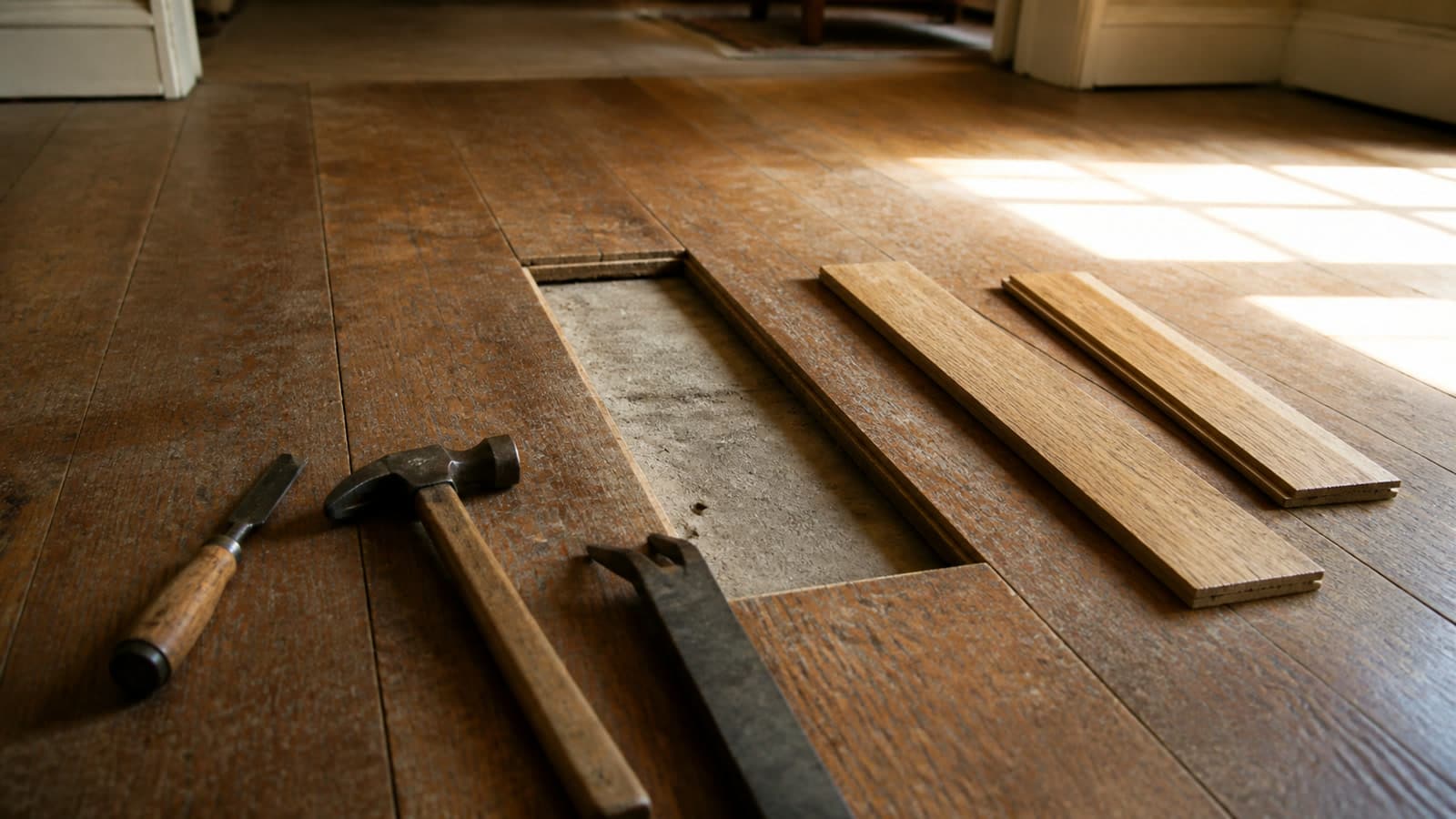
Most wood floor damage is local. A floor with one ruined section rarely needs replacing to fix it, and the repair is usually a fraction of what people expect to pay.
A wood floor is made of parts, and parts can be replaced. That is the single biggest advantage it has over almost every other floor covering.
A damaged board can come out and a new one go in, in the middle of a room, without disturbing anything around it. A section ruined by a leak can be cut out and rebuilt. A floor that has been in a building for eighty years has usually had this done to it more than once.
So the first question is almost never whether it can be fixed. It is how much of the surrounding floor has to be involved to make the fix disappear.
Six problems, and what each one usually turns out to need.
From a leak above, an appliance, a radiator or a bathroom. Boards darken, swell and lift at the edges. The important thing is that the source is fixed and the area is properly dry before anything is repaired, because a repair laid into a wet subfloor fails. Once it is dry, the affected boards come out and go back. The dark staining almost never sands out, which is why the boards are replaced rather than refinished.
Furniture dragged, something heavy dropped, a claw mark. Shallow ones sand out. Anything you can catch a fingernail in is into the wood, and depending on how deep it is that is either a fill or a board replacement.
Usually a fixing that has failed rather than a board that has. Often it can be refastened from above and the fixing hidden. Where the tongue has broken, the board is replaced.
Movement between the board and what it is fixed to, or between the subfloor and the joist. It is a fixing problem, not a wood problem, and it is usually fixable without taking the floor apart.
Wood shrinks in dry heat and opens up in winter. Seasonal gaps that close again in summer are normal and are best left alone. Gaps that stay open all year can be filled, and where they are wide across a whole floor the honest answer is sometimes that the floor is at the end of its life.
Board edges higher than their centres, caused by moisture underneath. Sanding it flat before the moisture is dealt with is the classic mistake, because when the wood dries the boards go the other way and you are left with a crowned floor. The moisture comes first, then time, then flattening.
Send a photo of the damage. Most repairs can be scoped from one good picture.
Call (929) 693-6422This is the question that actually matters, and it is the one nobody in this market answers honestly.
New wood is not old wood. A replacement board is a different age, it has a different grain, and it has not had years of light on it. Put a new board into a fifty year old floor and finish it on its own, and you will see it.
There are three levels of answer. In a closet or under a permanent piece of furniture, a straight patch is fine and nobody will ever look. In a visible area we blend, which means choosing boards for grain and colour, weaving the joints so the repair does not read as a rectangle, and staining to match. It gets close. In a room where the damage is in the middle of the floor and you will be looking at it every day, the repair is done and then the whole room is sanded and refinished together, and at that point it genuinely disappears.
We will tell you which of those three your job wants before we start, and the price difference between them is large.
The decision that changes the cost most.
Right when the damage is out of the way, when the rest of the floor is in good condition, or when the budget says fix the problem and nothing else. Fast, and much cheaper.
Right when the repair is somewhere you will look every day, and when the rest of the floor was already tired. You are paying for a refinish you were probably going to need anyway, and the repair becomes invisible as part of it.
A middle option that works when the surrounding finish is sound. It will not blend a new board perfectly, but it evens out the sheen across the room so the repair does not sit under a different surface.
Most repairs can be scoped from one good photograph. Send us the damage and we will tell you what it takes.
Call (929) 693-6422Nearly always. Wood is one of the few floor surfaces where a damaged part can be taken out and replaced without redoing the rest.
The cases where repair is not the answer are structural: widespread rot, a subfloor that has failed, or a floor so thin and worn across its whole area that patching it would be spending money on something already at the end of its life.
Yes. Individual boards, or a whole area, can be cut out and rebuilt in place.
The work is in making it look like it was never done. That is about board selection, weaving the joints so the patch has no straight edges, and matching the finish. How far we take that depends on how visible the area is.
Close, and often very close, but honestly it depends on where it is and what you are willing to do.
A blended repair with matched boards and stain looks right to almost everyone almost all the time. If you want a repair that is genuinely undetectable in the middle of a room you look at daily, the answer is to repair and then refinish that room as one, which resets the whole floor to the same age.
Often yes, and how much is saved depends on how fast it dried and what is underneath.
The order matters. Fix the source, dry the area properly, then repair. Swelling sometimes relaxes as the wood dries out, so it is worth waiting rather than cutting boards out on day two. Dark staining is in the timber and does not sand out, so those boards are replaced.
Refastening a loose board or filling a small gap is a reasonable job to take on.
Cutting a board out of the middle of a fitted floor is harder than it looks, because the boards are locked to their neighbours on all four sides. Getting one out without damaging the ones around it, and getting a new one in without a visible joint, is the part that takes practice. Damaging two more boards while removing one is the common outcome.
Less than people expect for the repair itself, and the range is driven by size and access rather than by the damage being dramatic.
The bigger cost decision is the one above: repair alone, or repair plus refinishing the room to blend it. A small patch in a closet and an invisible repair in the middle of a living room are very different jobs.
A straightforward board replacement is usually a single visit.
Water damage takes longer because the area has to be genuinely dry first, and that is a waiting period rather than a working one. If the room is being refinished to blend the repair, add the normal refinishing schedule on top.
Where the repair is best finished by resetting the whole room together.
Where the boards are sound and only the surface is tired.
Where a floor is genuinely past repairing.
Tell us what happened and where it is in the room. We will tell you whether it is a patch, a blend or a repair with a refinish, and what each would involve.