
Vinyl plank flooring
The better answer wherever water is a real risk.
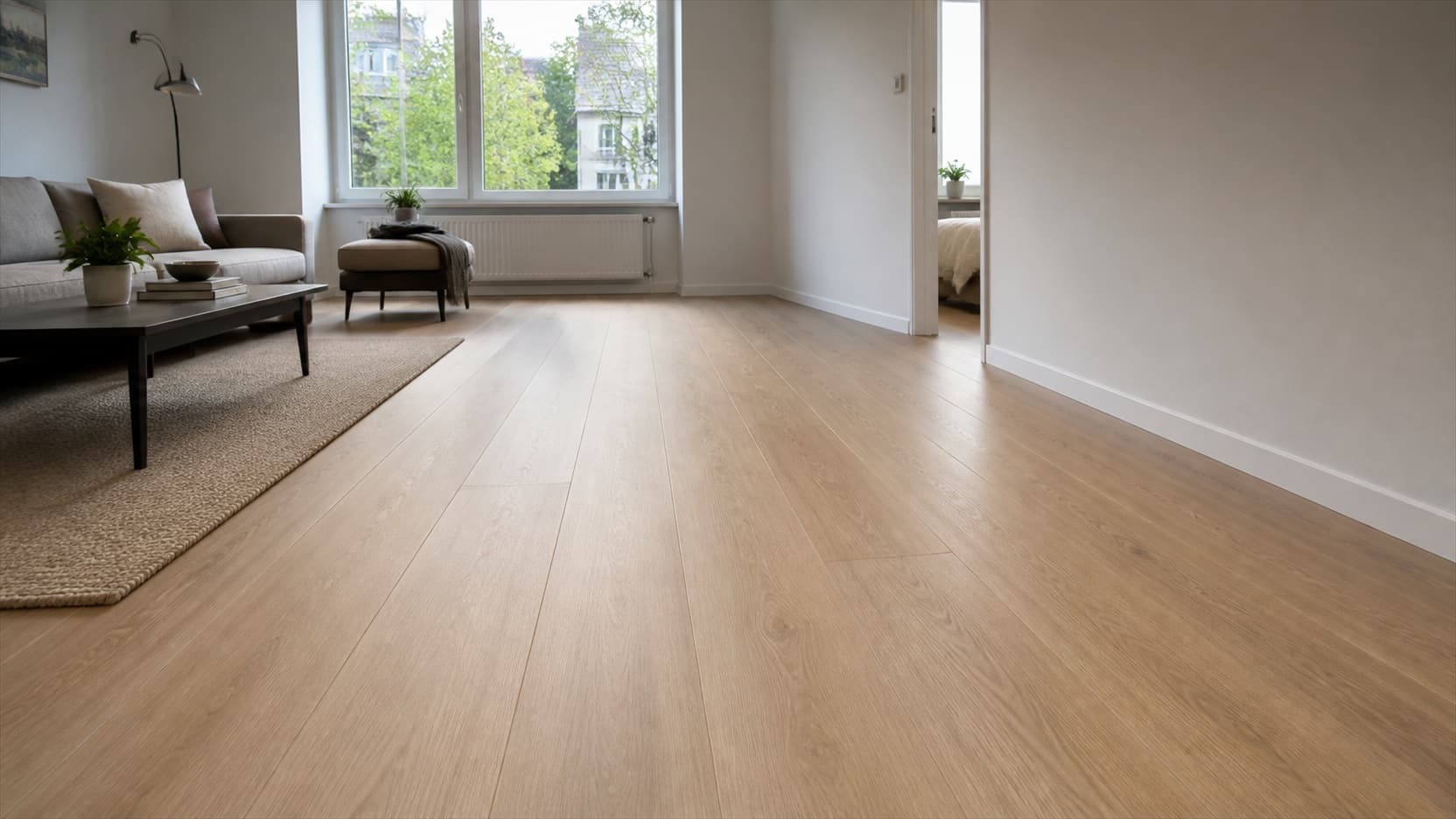
Laminate is the fastest hard floor to fit and usually the cheapest. Whether it can go straight over what is already there decides most of the price, and that is worth finding out before you shop.
Laminate is a dense fibreboard core with a printed photographic layer on top and a tough clear wear layer over that. It is not wood, and it is not pretending to be for anyone looking closely.
What it is very good at is taking punishment. The wear layer resists scratching better than a wood finish does, which is why it holds up under dogs, children, bikes in a hallway and furniture that gets moved.
It clicks together and floats, meaning it is not fixed down to anything. That is why it goes in fast, and why it can often be laid straight over a floor that is already there.
It is a good, honest choice for a rental, a busy family apartment, a room that takes hard use, or any job where the budget matters more than having real timber underfoot. We fit a lot of it in Queens for exactly those reasons.
Whether the old floor stays or goes. It is a bigger swing than the laminate you choose.
Over tile, vinyl, or a sound wood floor that is flat and firmly fixed, laminate can normally float straight over the top. No demolition, no disposal, no dust, and a day saved. This is the cheap and easy case.
Carpet and underlay have to go. They compress, and a floating floor over something soft flexes at the joints until the joints fail. Removal is quick and disposal is the main cost.
A floating floor copies whatever is under it. Loose tiles, damaged boards or a floor with real dips have to be dealt with, either lifted or levelled, before anything goes down.
The other thing to check is height. Adding a floor over an existing one raises it, which affects doors, thresholds and the gap under your baseboards. We measure that at the start rather than discovering it at the end.
Tell us what is on your floor now and we will tell you whether laminate can go straight over it.
Call (929) 693-6422Flat, dry, clean and firm. Flatness is the one that matters most, because a floating floor that bridges a dip will flex there, and constant flexing is what breaks click joints.
A foam or acoustic layer goes down first. It evens out small imperfections, cushions the floor slightly, and cuts the hollow sound a floating floor otherwise makes. Over concrete it also carries the moisture barrier.
We plan the first row so the last one is not a sliver, and choose the direction for the room and its light. Expansion gaps are left at every wall, because a floating floor has to be able to move.
Boards click together row by row, with the joints staggered so the floor is not weak along a line. Cuts around doorframes, radiator pipes and thresholds are the slow part and the part that shows.
Baseboard or shoe covers the expansion gap. Thresholds go in where the floor meets another surface. This is what makes it look fitted rather than laid.
The first is sound. A floating floor over a concrete slab can carry footfall to the apartment below more than a glued or nailed floor does. Acoustic underlayment deals with most of it, and many buildings have a view about which one to use. In a co-op or a condo, that view is worth finding out before you buy anything.
The second is water. Laminate has a fibreboard core, and standing water that gets into a joint will swell it permanently. It handles a wiped-up spill perfectly well. It does not handle a leaking dishwasher or a bathroom floor. For those rooms, vinyl plank is the right product and we would say so rather than sell you the wrong one.
Tell us the rooms and what is down now, and you will get a price with the removal question already answered.
Call (929) 693-6422Fitting laminate is one of the cheaper flooring jobs, and the labour is fairly predictable because the process is consistent.
What moves the total is whether an existing floor has to come up and be disposed of, whether the subfloor needs levelling, and how cut-up the space is. A simple open room over a sound existing floor is the low end. A carpeted apartment with several small rooms and a lot of doorways is the high end.
Often yes. Over tile, vinyl or a flat, sound, well fixed wood floor, laminate normally floats straight over the top with the underlayment between.
It cannot go over carpet, and it should not go over anything loose, damaged or noticeably uneven. The other limit is height, since the floor gets higher and the doors may not clear.
Yes, always an underlayment. It evens out small irregularities, softens the step, and cuts the hollow sound a floating floor makes without it.
Over concrete you also need a moisture barrier, either built into the underlayment or laid separately. In an apartment building an acoustic underlayment is often worth the difference, and sometimes required.
It is the most realistic flooring job to take on yourself. The boards click together and no adhesives or nails are involved.
The parts that separate a good result from an obvious one are setting out so the last row is not a thin strip, keeping the expansion gaps consistent, and cutting neatly around doorframes and thresholds. Those cuts are most of the skill and most of the time.
A straightforward room is often a single day, and a whole small apartment can be a couple of days.
Add time if an existing floor has to come up, if the subfloor needs levelling, or if there are a lot of doorways and awkward cuts. Unlike a wood floor there is no finish to dry, so the room is usable as soon as the trims are on.
No. Water resistant products exist and they cope well with spills wiped up promptly, but the core is fibreboard and standing water that reaches a joint will swell it, permanently.
For a bathroom, a laundry area, a basement or anywhere a leak is a real possibility, vinyl plank is the product designed for it.
No. The surface is a printed layer under a wear coat, so there is nothing to sand and nothing to recoat. When it is worn, it is replaced.
That is the genuine trade-off against real wood. Laminate resists damage better day to day, and wood can be brought back many times over a much longer life.
The better answer wherever water is a real risk.
Real timber, a longer life, and a floor that can be refinished.
If there is a wood floor under that carpet, it may be worth saving instead.
Tell us the rooms, the rough area and what is on the floor now. We will tell you whether it can stay and what the job would involve.