
Buff and recoat
If the finish is worn but the wood underneath is sound. One day, no sanding, much less cost.
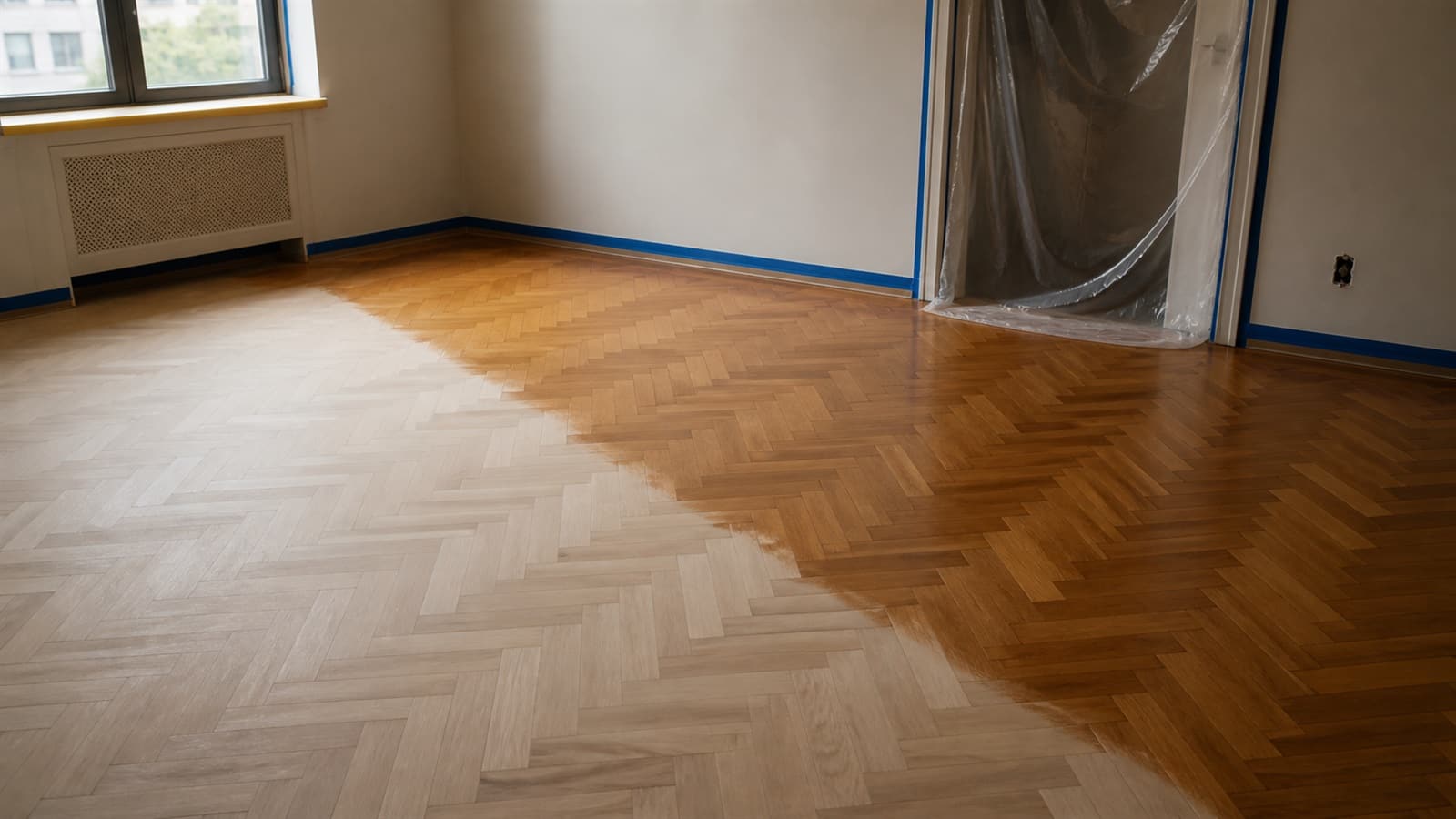
Refinishing takes a worn wood floor back to bare timber and builds a new finish on it. Most Queens floors that look finished are still candidates, and some are better off with a recoat instead.
The finish on a wood floor is a clear coat sitting on top of the wood. It is what wears, not the timber. Once it thins through, the wood underneath starts taking the damage instead, and that is when a floor goes grey and rough in the walkways.
Refinishing sands off the old finish and a fine layer of wood with it, takes the surface back to clean bare timber, and builds a new finish on top. Scratches, stains and grey patches that live in the old coating disappear with it. Colour can change at the same time if you want it to.
The result is not a repaired floor. It is the same floor with a new surface, which usually looks better than people expect, because they have been looking at a worn coating for years and had forgotten what the wood underneath looks like.
Three different jobs at three very different prices. Getting this right is worth more than anything else on this page.
The surface is dull and lightly scratched, but the wood underneath is still sealed and clean. We abrade the old finish and lay a fresh coat over it. One day, no sanding, the least disruption and the lowest cost.
Grey patches, dark stains, deep scratches you can feel, or bare wood showing in the traffic lanes. The coating has failed and the timber is taking the wear. Sanding is the only thing that reaches it.
Boards sanded so many times that the tongue is close to the surface, cupping that will not flatten, or widespread structural damage. At that point sanding makes the problem worse and a new floor is the honest answer.
We tell you which of these your floor is before you commit to anything. It is a five minute judgement in person and it is not one anyone can make properly from a photo.
Most of the prewar and mid-century apartment stock in Queens has parquet floors. The garden co-ops around Jackson Heights have had them since they were built in the 1910s and 1920s. So do a great many of the buildings in Sunnyside, Forest Hills, Rego Park, Kew Gardens and Fresh Meadows.
Parquet is not sanded like a strip floor. The grain runs in several directions inside the same square, so a machine driven the way you would drive it along boards tears the fibres on half of them. It is cut at an angle to the pattern, in stages, with the final passes taking out the marks from the earlier ones.
The bigger question with parquet is thickness. A lot of it is thin to begin with, and much of it in this borough is glued down over a concrete slab rather than nailed over joists. Every sanding takes wood off, and there is a point where the next one goes through. If your floor is close to it, we will tell you, and a recoat will keep it going for years instead.
Patterned parquet is worth saving. Herringbone and basketweave are not things anyone is laying in an apartment renovation today, and a hundred year old floor brought back cleanly is better than anything you would replace it with.
Five stages. Most of them are quieter than you would think, and one of them is not.
Wood type, thickness left, what the old finish is, where the damage is and what is under the boards. This is where we confirm whether it is a refinish or a recoat, and it happens before any final number.
The room is cleared, baseboards are taped, doorways to rooms we are not touching are sealed, and anything that stays gets covered. Loose boards are fixed and protruding nails are set below the surface, because either one will destroy a sanding belt and mark the floor.
Coarse, then medium, then fine, each pass removing the marks of the one before. Edges and corners are done separately with a smaller machine, and the last work in the tight spots is done by hand. This is the loud day.
Colour goes on bare wood and nowhere else, so this is the only moment it can happen. It adds a day. We put samples down on your own floor first, because stain reads completely differently on your wood in your light than it does on a card.
Coats go on with drying time between them. More coats means more wear resistance and more days. When the last one is down the floor is finished, but it is not ready, and the next section is about the difference.
Send a photo of the worst part of your floor and we will tell you whether it needs sanding or just a coat.
Call (929) 693-6422Sanding a floor turns part of that floor into dust. Nobody has a machine that avoids it. What separates a clean job from a bad one is whether the dust is captured at the cutting head or left to find its own way around your home.
Our machines run connected to vacuum extraction, which takes the great majority of it at the source. We seal the doorways to rooms we are not working in, cover what has to stay in the room, and clean down between passes rather than only at the end.
You will still find a fine film on surfaces afterwards, particularly on the tops of things at head height. That is normal and it wipes off. We would rather tell you that now than have you discover it on the last day.
If anyone tells you their sanding leaves no dust at all, they are describing a machine that does not exist.
The three questions the rest of this market leaves you to guess at.
Area first, then condition. A sound floor that needs sanding and coating is the cheapest case. Water damage, boards to replace, old adhesive or paint, and heavy pet staining all add work before the sanding starts. Stairs are expensive per step because almost none of it can be done by machine. Stain adds a day. More coats add days. Small rooms and lots of closets cost more per square foot than one big open space, because the machines spend less time cutting and more time turning around.
Because the number that matters is the one for your floor, and the difference between the cheap case and the expensive one on the same size apartment is large. A per foot figure on a website is either so wide it tells you nothing or so narrow it is wrong for most people. We look, we measure, and you get a figure that holds.
For an average apartment, three to five days from the first sanding pass to the last coat. Add a day for stain. Add time for board replacement or serious preparation. A recoat is one day. A house done room by room takes longer overall but leaves you somewhere to live throughout.
You can usually walk on it in socks within a day of the last coat. Furniture can come back in a few days. Rugs are the one people get wrong: a new finish needs to cure properly before anything airtight sits on it, and that takes longer than it takes to dry. We give you the date at the start of the job rather than at the end of it.
Send the room count and a photo and we will come back with what your floor needs and what it involves.
Call (929) 693-6422It depends on the area and the condition, and those two vary more than people expect between apartments of the same size.
The drivers are listed above. Rather than guess, we look at the floor, measure it and give you a figure for your job. If a recoat would do instead, that is a much smaller number and we will say so.
Refinishing is almost always cheaper, usually by a wide margin, and it keeps a floor that is often better than the one you would buy to replace it.
Replacement wins only when there is not enough wood left to sand, when the boards are structurally gone, or when the floor is failing across most of its area. We will tell you if you are in that position.
You can rent the machines, and people do it successfully. It is worth knowing what you are taking on first.
A drum sander removes wood quickly and does not forgive being held still. The most common outcome of a first attempt is a dished patch or a line of chatter marks that only show up once the finish goes on, at which point fixing it means sanding the whole floor again.
If your floor is thin, old parquet, the margin for error is smaller again, because you may only have one sanding left in it.
It depends on the thickness of wood above the tongue, not on the age of the floor. A solid strip floor might take several sandings across its life. A thin parquet, or an engineered board with a wear layer of a few millimetres, might have one.
This matters in Queens because so much of the apartment stock is older parquet that has already been done more than once. We check what is left before we sand, and if the answer is not much, a recoat is the way to keep it.
Yes, and they usually should be. Parquet responds well to refinishing and the patterned floors in particular are worth keeping.
The method is different from a strip floor because the grain runs several ways in the same field, so the machine is worked at an angle to the pattern and the finer passes clean up the coarser ones. The limit is thickness rather than pattern.
For a recoat, usually yes. For a full refinish of a whole apartment, most people go elsewhere for two or three nights.
The rooms being worked on are out of use, the sanding day is loud, and the finish has a smell for the first day. In a house, or in an apartment where we can do it room by room, staying is normally workable.
Mostly the schedule rather than the work. A co-op will want the job approved before it starts, and approval takes as long as the managing agent takes, so it is worth beginning that early rather than the week before.
Sanding is also the loudest thing we do, so the building's permitted hours matter more for a refinish than for a recoat. A whole-apartment refinish is several days of it.
The other co-op question is the floor itself. Much of the borough's co-op parquet is thin and has been sanded before, so it is worth knowing what is left before you commit to sanding rather than recoating.
The full picture of what a building asks for is on our service areas page.
The two jobs people most often actually need instead.
If the finish is worn but the wood underneath is sound. One day, no sanding, much less cost.
If the problem is one damaged area rather than the whole floor.
Board approval, working hours, the rug rule, and what parquet over a slab means.
Send the rooms, the rough area and a photo of the worst part. We will tell you whether it is a refinish, a recoat or a repair before anyone commits to anything.