
Laminate flooring
Harder wearing day to day, and a better buy in dry rooms.
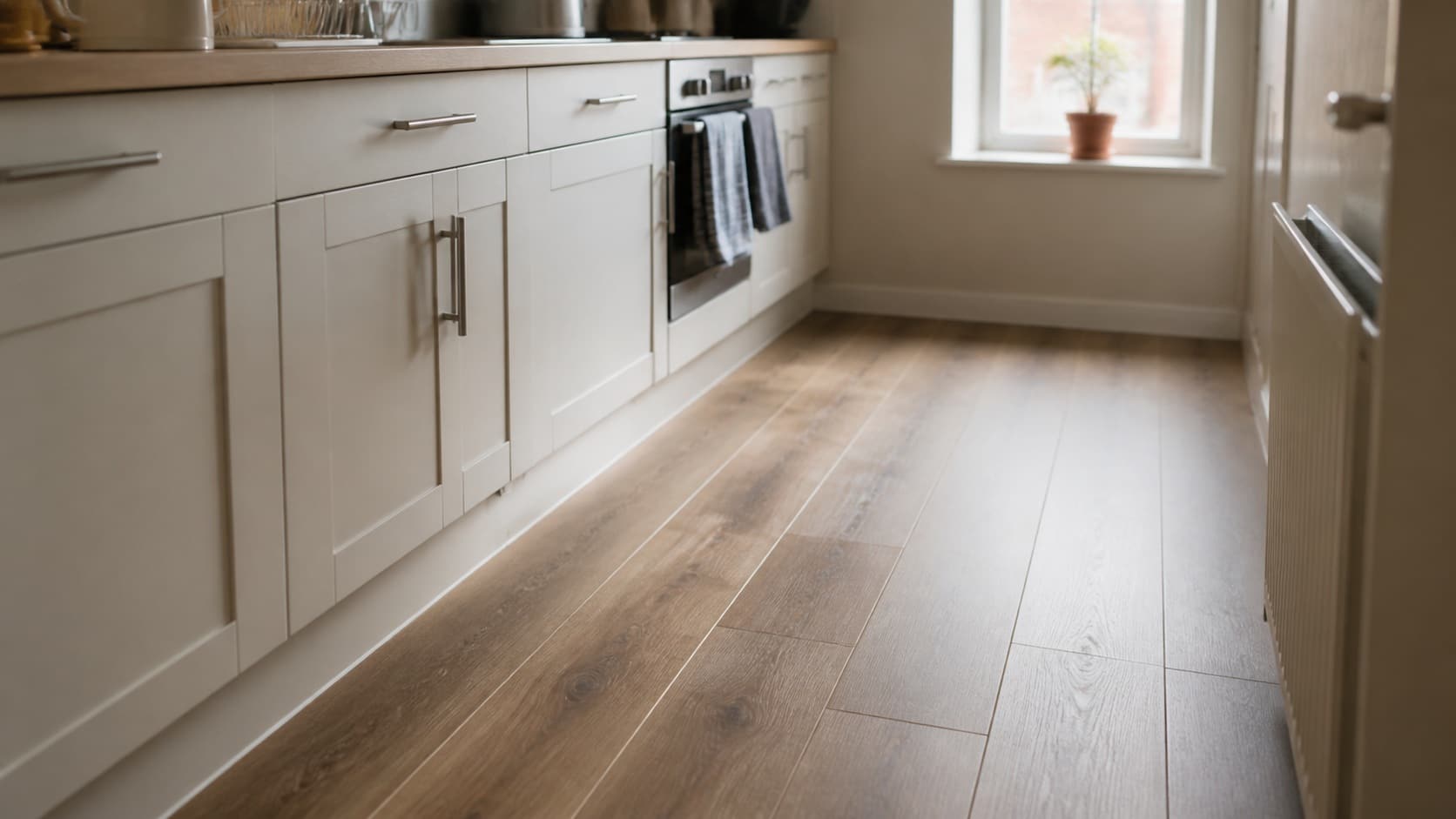
Luxury vinyl plank is chosen for water. That makes it the right floor for the rooms where wood is a risk, and the wrong one for rooms where it is not.
Luxury vinyl plank is a layered plastic board with a printed surface and a clear wear layer. The whole board is waterproof, not water resistant. Soak it and it is unaffected.
That single property is why it exists and why people buy it. A kitchen with a dishwasher, a bathroom, a laundry area, a basement, a ground floor apartment, a coastal property where the risk is real rather than theoretical. In all of those, wood is a gamble and laminate has a fibreboard core that swells.
It is also quiet, warm underfoot, and softer than tile to stand on, which matters in a kitchen. And the good products look considerably better than the reputation vinyl carries from thirty years ago.
What it is not is wood, and it will not be mistaken for it by anyone who looks closely. If the room has no moisture risk and you want real timber, we would point you at the hardwood pages instead.
The real installation decision, and it is made by the room rather than by preference.
Planks lock to each other and rest on the subfloor. Faster, cheaper to fit, and it can go over some existing floors. Best in ordinary rooms of moderate size.
Every plank bonded to the subfloor with adhesive. More work and more preparation, but the floor cannot shift, cannot gap at the joints, and does not react to temperature swings. This is the answer in large open areas, in rooms with a lot of direct sun, over underfloor heating, and in commercial use.
A normal apartment room, floating. A big open space, a very sunny room, or anywhere the floor absolutely must not move, glued. If a manufacturer specifies one method for the product you have chosen, that decides it, because using the other one usually voids the warranty.
Vinyl expands and contracts with temperature more than wood does with humidity. A floating floor in a room with strong direct sun and no expansion allowance is the classic way to end up with lifted joints.
Not sure whether your room needs glue down or floating? Tell us which room it is and we will say.
Call (929) 693-6422This is the thing people get wrong about vinyl plank. Because the boards are thin and flexible, they do not bridge anything. They follow the surface underneath exactly.
A wood floor is stiff enough to span a small dip. Vinyl plank sits down into it, and every ridge, lump, old adhesive ridge and screw head telegraphs through to the surface where you will see it in raking light forever.
So the preparation is genuinely more demanding than for the products people think of as more serious. A subfloor for vinyl plank needs to be smooth as well as flat, which often means a levelling compound rather than just a check with a straightedge.
Moisture testing over concrete matters too, particularly for a glued installation, because the adhesive has to bond to a dry slab to hold.
Flatness, smoothness, soundness and moisture. This is where a vinyl job is won or lost and it is where the time goes.
Old adhesive off, high spots ground down, low spots filled, and a levelling compound where the surface needs it. Over concrete, a moisture check and the right barrier or primer.
The planks sit in the room before fitting so they are at the temperature they will live at. Skipping this is the most common cause of gapping at the joints a month later.
Planned so the last row is a sensible width, joints staggered, expansion allowance at the perimeter for a floating floor, or adhesive trowelled and planks laid into it for a glued one.
Trims and thresholds fitted. In a kitchen or bathroom the perimeter and the line at the toe kick are sealed, because a waterproof floor with an open edge lets water underneath and defeats the point of it.
Kitchen, bathroom or basement? Tell us the room and we will tell you which method and what the subfloor will need.
Call (929) 693-6422The laying itself is comparable to laminate. The variable is preparation, and with this product preparation is a bigger share of the job than with any other floor we fit.
A smooth, flat, dry subfloor is the cheap case. A floor that needs old adhesive removed and a levelling compound applied is a different job with a different number. We will tell you which one you have after looking.
Not always. Many products are click systems designed to float, and in an ordinary room that is a perfectly good installation.
Glue down when the area is large and open, when the room gets strong direct sun, over underfloor heating, in commercial use, or when the manufacturer specifies it. Using the wrong method for a given product is a common cause of failure and usually voids the warranty.
Less than people expect, and preparation instead. Many LVP products have an attached backing and adding a separate underlayment under them can make the floor too soft and stress the joints.
What is needed is a smooth, flat, clean, dry subfloor, plus a moisture barrier over concrete. Where an underlayment is used it should be the one the manufacturer specifies for that product, particularly if acoustic performance is required by your building.
Four, and they account for most of the failures we get called to look at.
Laying over a subfloor that is flat but not smooth, so every imperfection telegraphs through. Not letting the planks acclimatise, so joints gap later. Leaving no expansion allowance on a floating floor in a sunny room, so it lifts. And leaving the perimeter unsealed in a wet room, so water gets underneath a waterproof floor and sits there.
For water, yes, decisively. The whole board is waterproof rather than water resistant, so it belongs in kitchens, bathrooms, basements and anywhere a leak is plausible.
For scratch resistance, a good laminate is generally harder wearing. For a dry living room with a dog, laminate is often the better buy. They are different tools and the room decides which one.
Sometimes, and less often than with laminate, because of how faithfully vinyl copies what is underneath.
Over sound, flat, smooth tile or vinyl it can work, though grout lines may need filling first or they will show through. Over carpet, never. Over anything uneven or loose, it has to be dealt with first.
Buildings care about sound transmission, and a hard floating floor over a slab is exactly what they ask about.
Many require a specified acoustic underlayment, and some have a view about hard flooring in general. It is worth checking your building's rules before choosing a product. We work to whatever it specifies.
Harder wearing day to day, and a better buy in dry rooms.
Real timber, where the room has no moisture risk.
Underlayment rules, sound, and what a slab means for the job.
Which room, how big, and what is on the floor now. We will tell you whether vinyl plank is the right call and what the subfloor will need first.