
Hardwood floor refinishing
When the wear has reached the wood, or you want to change the colour.
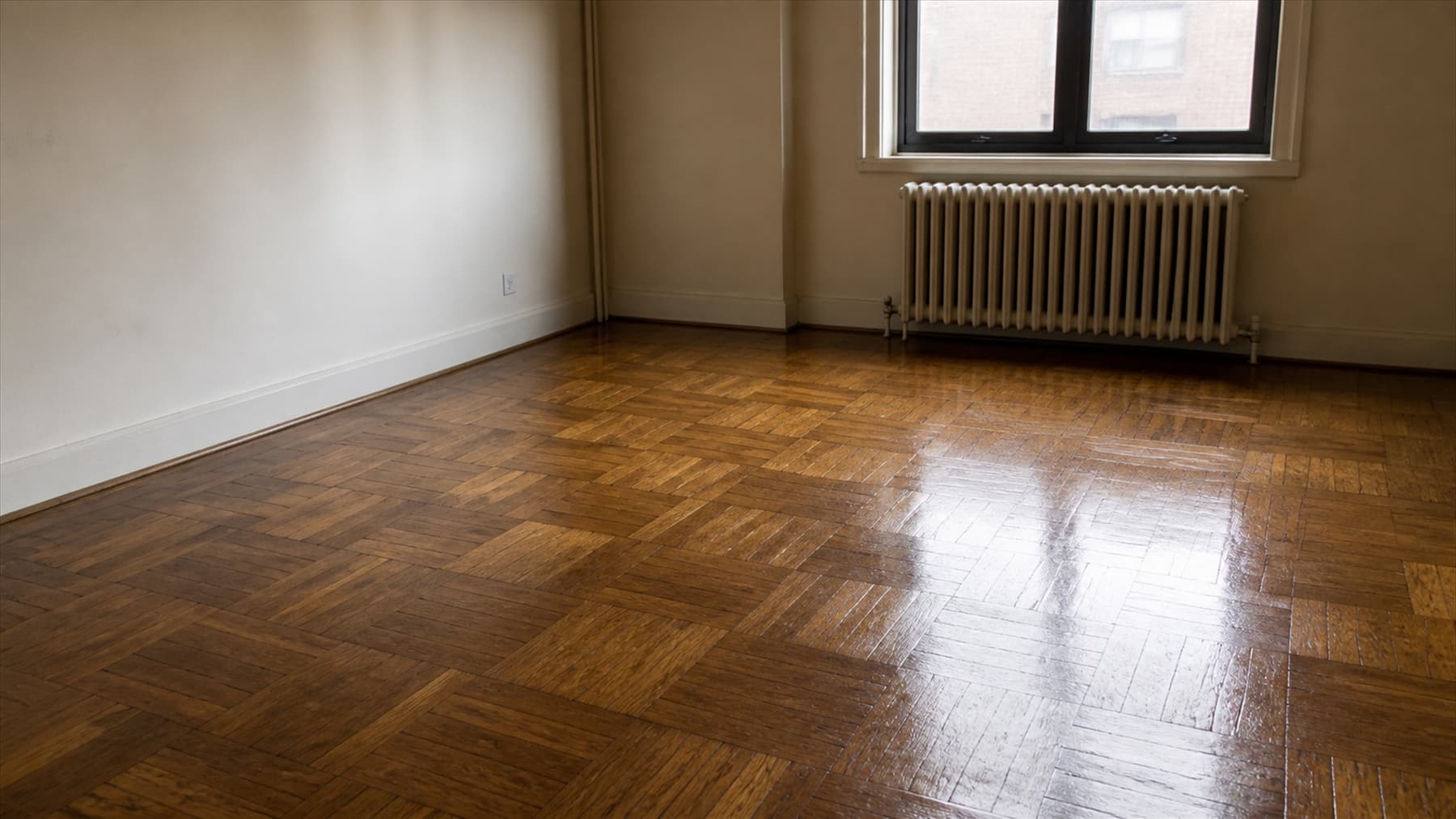
A buff and recoat renews the finish without touching the wood underneath. It is usually one day, it costs a fraction of a refinish, and for an old parquet floor that could not take another sanding it is often the only right answer.
A wood floor wears from the top down. The clear finish takes the traffic first, and for a long time all the damage is in that coating rather than in the timber.
A buff and recoat works entirely in that layer. We abrade the existing finish with a buffer to take off the surface gloss and give the new coat something to grip, clean the floor thoroughly, and lay a fresh coat of finish over it.
No sanding happens. No wood is removed. The floor is not taken apart and put back together, it is given a new surface over the one that is already there.
That is why it is one day instead of a week, why it costs a fraction of a refinish, and why it is repeatable in a way that sanding is not.
Most apartments in Queens are co-ops, a far higher share than in Brooklyn or Manhattan. A great deal of that stock is original parquet, and a great deal of that parquet is glued down over a concrete slab.
Parquet like that is thin to start with. Many of these floors have already been sanded once or twice across their lives, and each time took wood off that does not come back. There is a point where another sanding goes through the wear layer and the floor is finished for good.
A recoat does not spend any of that remaining thickness. It keeps a hundred year old floor looking cared for and buys it years, without using up the one full refinish it may have left.
So in a Queens co-op the question is often not whether you can afford a refinish. It is whether your floor can afford one.
A recoat needs a sound sealed surface to bond to. This is the test, and you can do most of it yourself.
The floor looks tired and flat, the shine has gone in the walkways, and there are fine scratches you can see but barely feel. The wood underneath is still sealed and clean. This is exactly what a recoat is for.
Grey or pale patches in the traffic lanes usually mean the finish is gone and the timber is taking wear directly. A coat over exposed wood will not match the sealed floor around it, and the difference will be obvious.
Dark water marks, pet stains and scratches you can catch a fingernail in are all in the wood, not in the finish. Nothing laid on top will hide them. That is a refinish.
A drop of water is a decent home test. If it beads and sits, the finish is intact and a recoat should bond. If it soaks in and darkens the wood, that spot is bare and it needs more than a coat.
Try the water test on the busiest part of your floor and tell us what happened. That one answer decides most of this.
Call (929) 693-6422We test a small area first. Some older finishes, and floors that have been polished with waxes or oil-based cleaners, will not accept a new coat and have to be dealt with differently. Finding that out before we coat the whole floor is the difference between a good job and a peeling one.
The room is cleared and the floor is cleaned properly. Any residue left on the surface ends up sealed under the new coat, so this stage is done thoroughly rather than quickly.
A buffer with a fine screen takes the gloss off the existing finish across the whole floor. This is not sanding. It removes the surface sheen and nothing else, and it makes far less dust than a sanding job.
The new finish goes on wet edge to wet edge across the room. In a normal apartment this is a matter of hours.
You can usually walk on it in socks the next day. Furniture comes back after that, and rugs last, once the finish has cured rather than merely dried.
A recoat renews the surface. It does not change the wood.
Deep scratches stay, because they are cut into the timber. Dark stains stay, for the same reason. Grey worn patches stay grey. Gaps between boards do not close. And colour cannot be changed, because stain only goes on bare wood, which means a colour change is a refinish by definition.
What you get is an even, clean, protected surface with its depth back, on a floor that keeps its own age and character. For most tired floors in sound condition that is exactly the right outcome, and it is available at a fraction of the alternative.
One day, no sanding, and much less cost. Send a photo and we will tell you whether your floor qualifies.
Call (929) 693-6422Refinishing sands the floor back to bare wood and builds a new finish from nothing. A recoat leaves the wood untouched and lays a new coat over the existing finish.
Refinishing fixes damage in the timber and can change colour. A recoat fixes the surface only. Refinishing takes several days and removes wood that never comes back. A recoat takes a day and removes nothing.
If the wood underneath is still sealed and sound, a buff and recoat is the answer, and most people are surprised how much of the original depth comes back.
If the wear has gone through to the timber, or there are stains and deep scratches, no surface treatment will do it and the floor needs sanding. The water test above tells you which of the two you are looking at.
Buffing on its own, with no coat after it, mostly just removes shine. It is worth doing as the preparation stage for a new coat, which is what a buff and recoat is.
Done on a regular cycle before the finish wears through, it is the cheapest way to keep a wood floor in good condition for decades. It is the maintenance step most floors never get, which is why so many end up needing a full sand.
The buffing is the easier half. The coating is where it goes wrong.
Finish has to go on evenly and keep a wet edge across the whole room, or it dries with visible laps and streaks that only show once it has cured. The other risk is bonding: if the old finish has wax or an oily cleaner residue on it, a new coat can fail to key and peel later. That is what our test at the start is for.
Many times. Because it removes no wood, it does not use up the life of the floor the way sanding does.
A floor kept on a recoat cycle before the finish wears through can go a very long time without ever needing a full refinish. That is the whole argument for doing it, and it matters most on thin old parquet.
Usually yes, as long as you can stay off the coated rooms until the next day.
There is far less dust than a sanding job and it is over in a day. The finish has a smell for the first several hours, so ventilation helps and some people prefer to be out for the evening.
Often less than for a refinish, because nothing structural changes and it is a single quiet day, but many buildings still want to know.
Assume the building will ask for a certificate of insurance and expect the work to happen in its permitted hours. New York City permits construction on weekdays from 7am to 6pm, and buildings frequently set a narrower window than that.
When the wear has reached the wood, or you want to change the colour.
When one area is damaged and the rest of the floor is fine.
Why parquet over a slab so often points to a recoat rather than a sand.
Send a photo of the busiest part of the floor and tell us what the water test did. That is usually enough for us to tell you whether a recoat will work.